




"Psykinematix is the most powerful and affordable standalone solution dedicated to Visual Psychophysics running on macOS. It consists in a unique OpenGL-based software package that does not require any programming skill to create and run complex experiments. Easy to use, subject-friendly, powerful and reliable, Psykinematix runs standard psychophysical protocols, presents complex stimuli, collects subject's responses, and analyzes results on the fly."
William BEAUDOT, President & Chief Vision Scientist at KyberVision Japan LLC
To learn more about the use of Psykinematix in clinical research, check out our VSJ 2009 paper: "Psykinematix: A New Psychophysical Tool for Investigating Visual Impairment due to Neural Dysfunctions".What Do Users Say About Psykinematix?
Psykinematix is an excellent tool for the rapid and accurate development of psychophysical testing. It allows for the swift conversion of ideas into experiments.Ben Thompson, University of Waterloo (Optometry & Vision Science)
I have recommended Psykinematix to students because it is a quality fast-track solution to experiment design and development.
Max Farrell-Whelan, Macquarie University (Department of Psychology)
SENDAI, Japan — January 13th, 2024 — KyberVision Japan LLC released today the all new Psykinematix Universal Editions: Psykinematix v1.9.4 Student & Standard Editions, and Psykinematix v2.6 GPU Edition that bring bug fixes, improvements, and more importantly full compatibility with Apple's latest macOS 14 "Sonoma" running on either Intel 64-bit or Apple M-Series Macintosh computers.
Psykinematix features in particular:
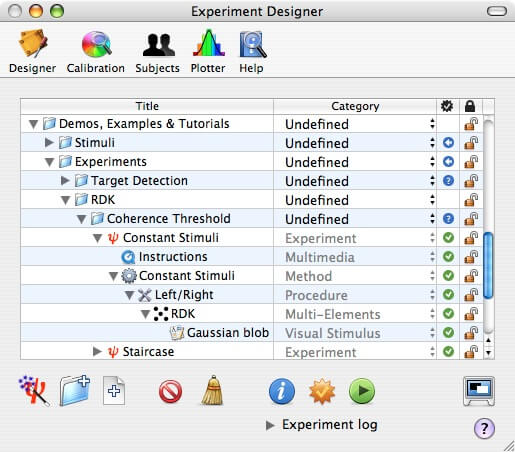
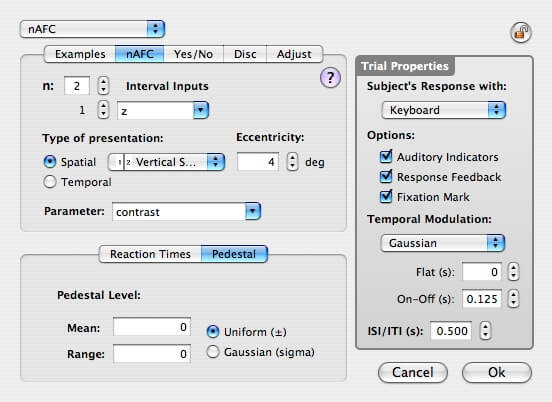
- Easy experimental design
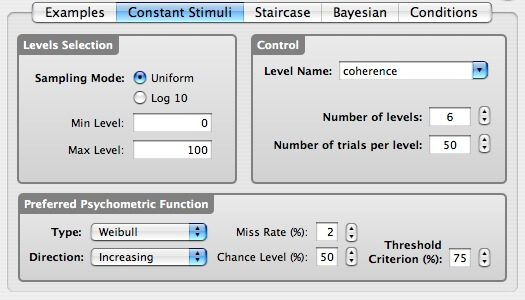
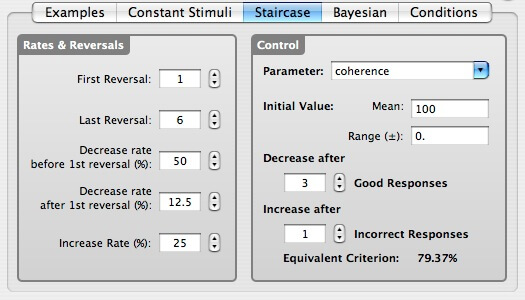
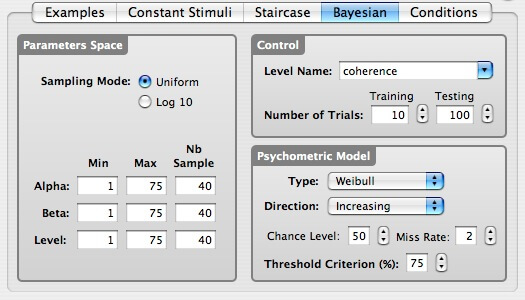
- Standard methods
- Standard procedures
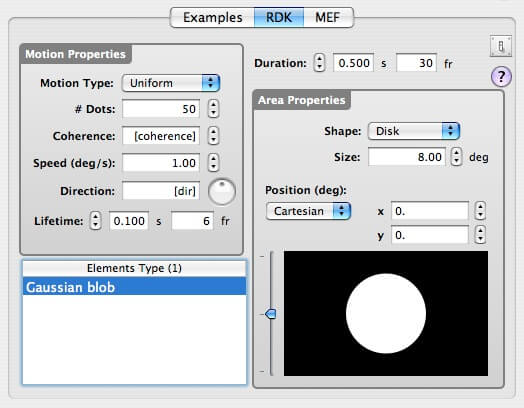
- A large variety of visual stimuli
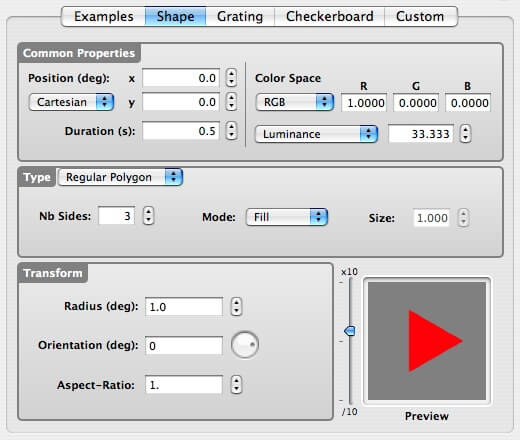
- shapes
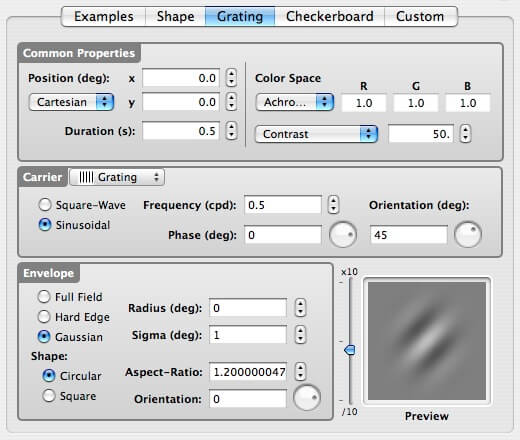
- carrier (grating, noise, etc) modulated by envelope
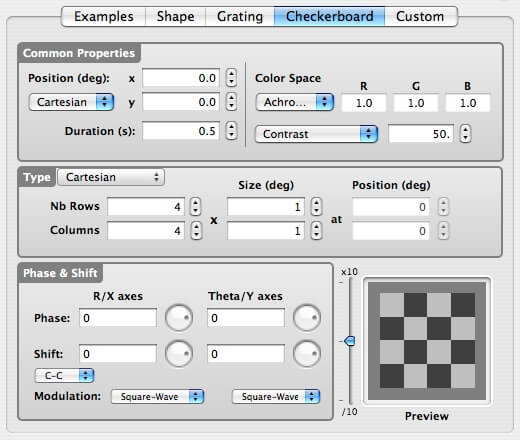
- checkerboard-like (cartesian or polar)
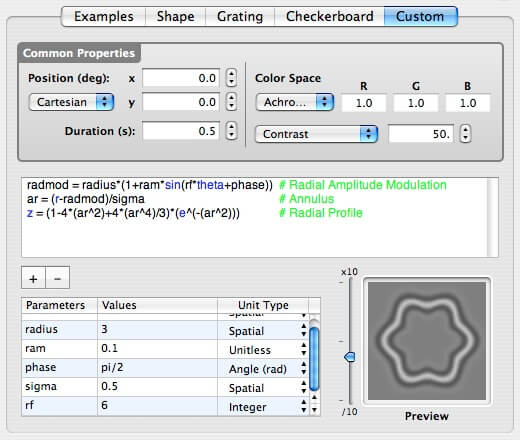
- custom (expression-based)
- Ishihara
- Composing
- static (1st, 2nd-order)
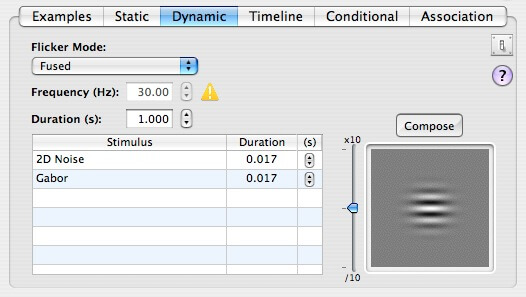
- dynamic (fusion, flickering, contrast reversal)
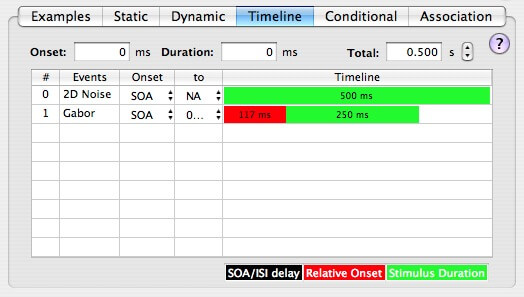
- timeline (SOA, ISI)
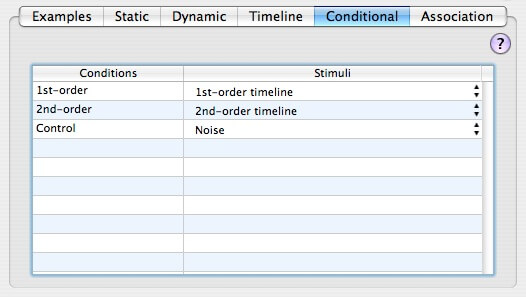
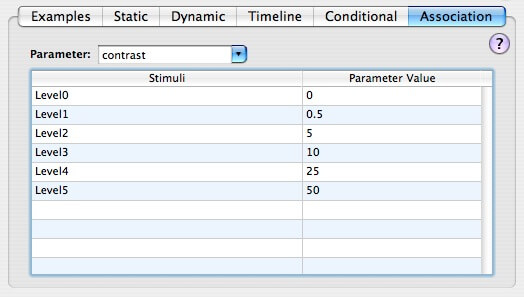
- conditional, association
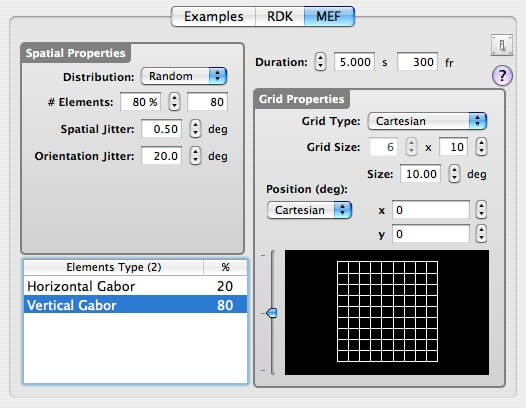
- Multi-Elements Stimuli
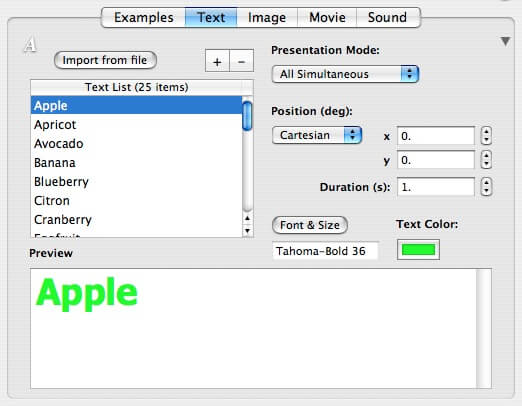
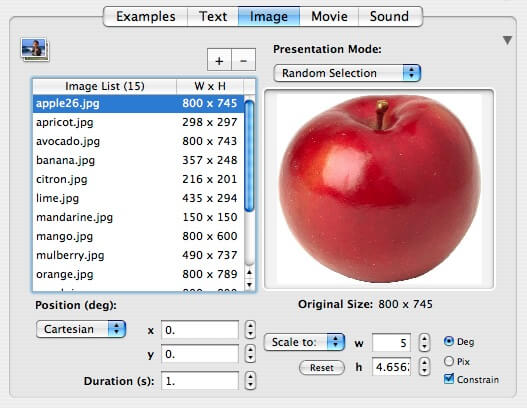
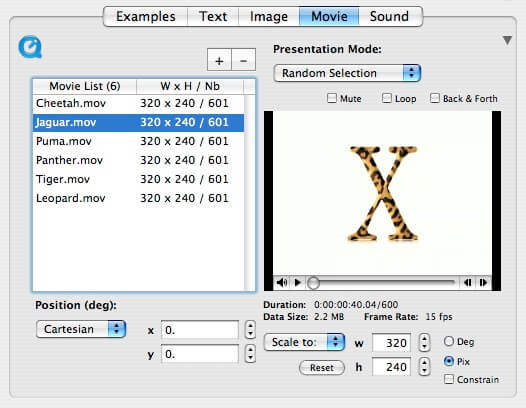
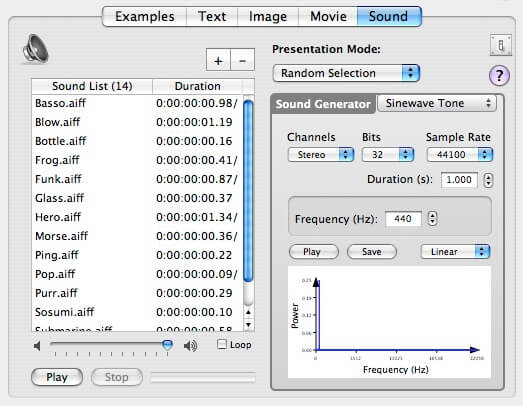
- Support for multimedia stimuli
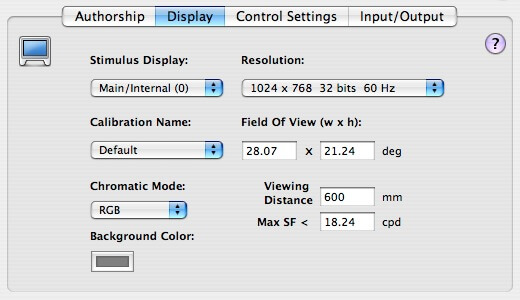
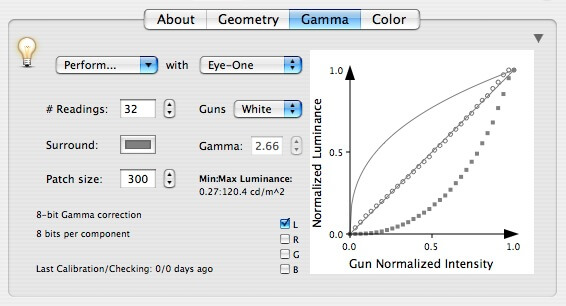
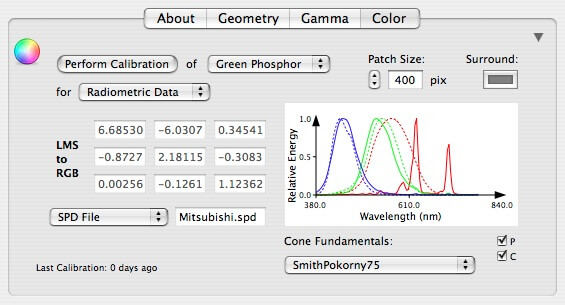
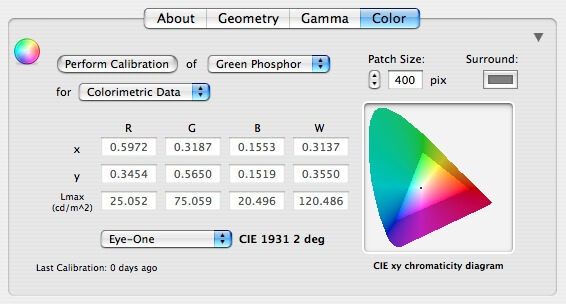
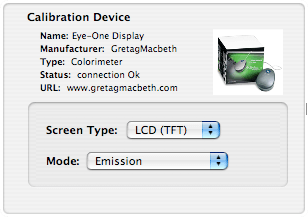
- Display calibration
- Color Spaces
- Achromatic, RGB, XYZ, LMS, HSB, L*a*b*
- xyY, Yu'v', L*u*v*
- Precise control of time-varying properties
- Enhanced Contrast Resolution (Bit-Stealing & Spatial Dithering up to 14-bit)
- Stereoscopic Stimuli (dual-display setup through Matrox DualHead2Go, anaglyph glasses, free viewing, or frame sequential)
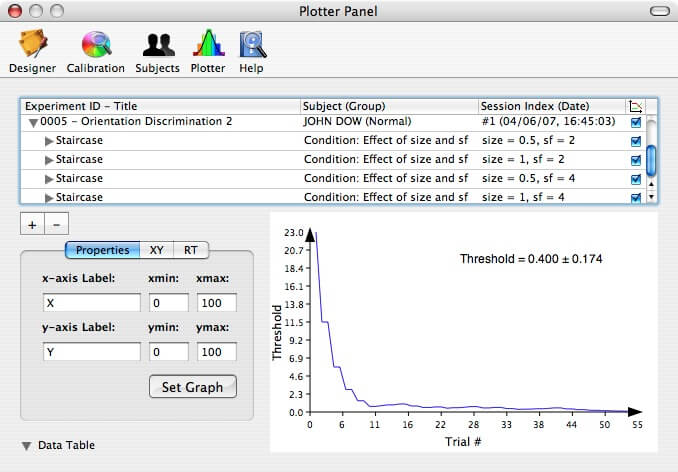
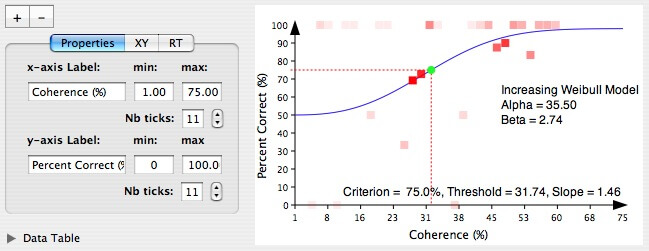
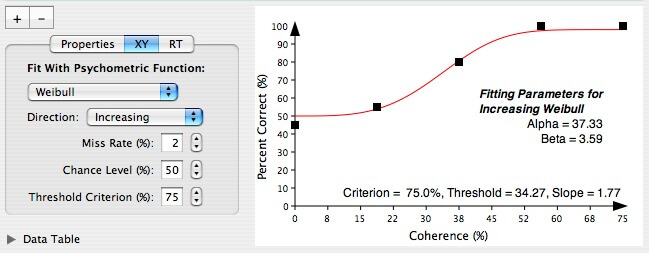
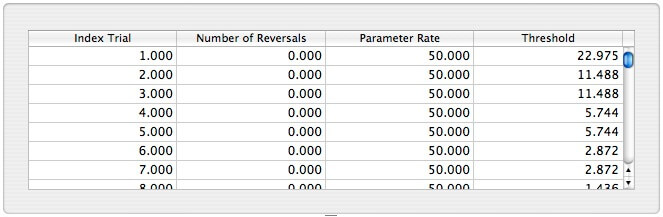
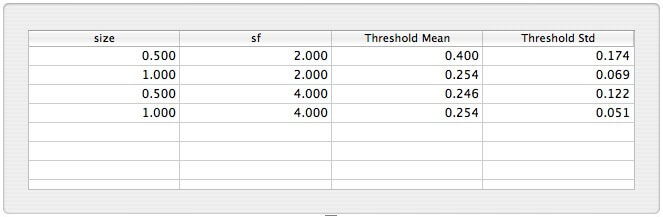
- Data plotting and fitting with psychometric functions
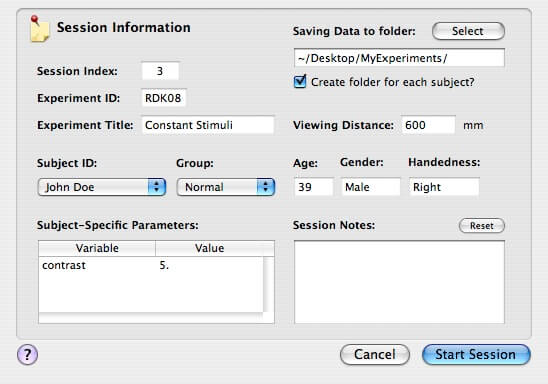
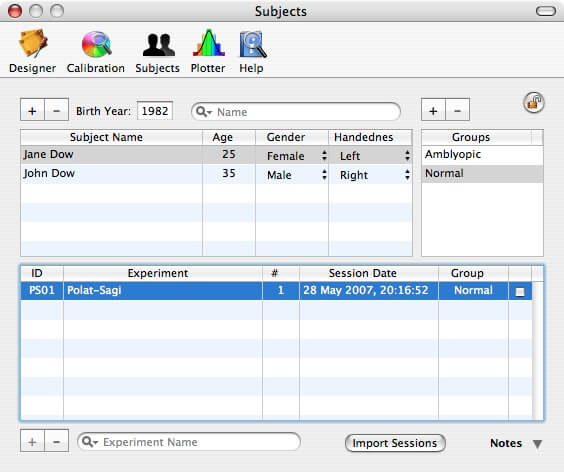
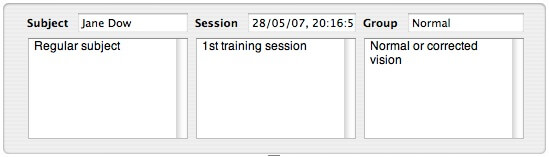
- Subjects, groups and sessions management
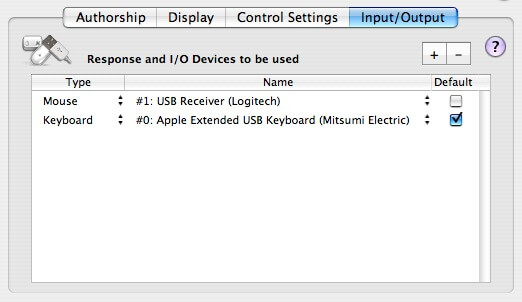
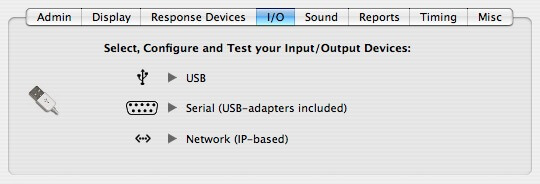
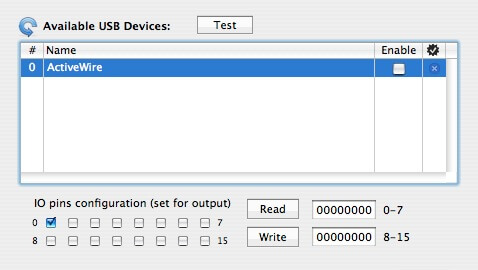
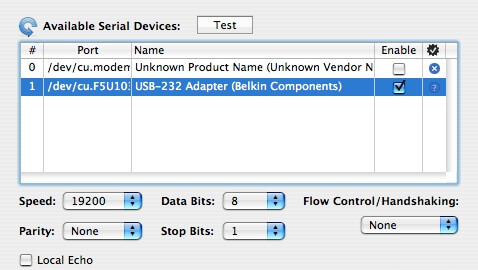
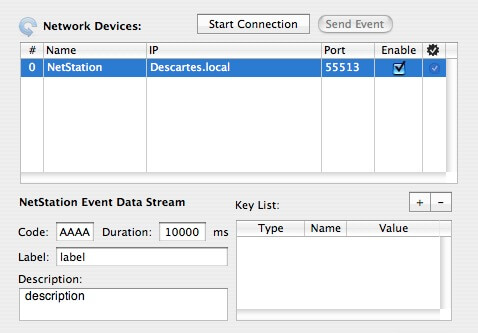
- Communication with external devices ( USB, serial, network, calibration)
- i1 Display 2 Colorimeter
- i1 Pro Spectrometer
- Spyder 3 Colorimeter
- Spyder 4 Colorimeter
- Spyder 5 Colorimeter
- Spyder X Colorimeter
- fORP device in keyboard mode
- ioLab Button Box
- Cedrus RB-x30 Response Pads
- Cedrus Lumina Response Pads for fMRI through LSC-400 controller
- EGI EEG NetStation
- Keypad, gamepad, joystick
- more to come...
- Easy export of stimuli (clipboard, image and movie files) and OpenGL preview
- Capture of frame sequence during experiment (by holding ESC key)
- Built-in documentation, more than 50 demos and examples, 15 tutorials








What are the hardware and software requirements ?
- Psykinematix v1.* can run on any Macintosh computer (either laptop or desktop) released since 2002 supporting at least Mac OS X 10.4 (Tiger) and with a minimum of 32MB of video memory, 512MB RAM, and a 800 Mhz processor. Psykinematix v1.* is provided as a 32-bit Universal application that runs natively on both PowerPC- and Intel-powered Macintosh computers under macOS 10.14 (Mojave) or lower, as a 64-bit application that runs on Intel-based Macintosh computers with Mac OS X 10.7 to macOS 10.15 (Catalina). The latest version is a provided as a Universal application that runs on both Intel 64-bit and Apple M-Series Macintosh computers with macOS 11 (Big Sur) or above.
- Psykinematix v2.* (GPU, Sharp and Metropsis Editions) is provided as a 64-bit application that runs on Intel-based Macintosh computers with Mac OS X 10.7 to macOS 10.15 (Catalina). The latest version is a provided as a Universal application that runs on both Intel 64-bit and Apple M-Series Macintosh computers with macOS 11 (Big Sur) or above.
Recommended system requirements for the latest version (as of January 2024):
Software:
- Minimum OS: macOS 11 ("Big Sur")
- Maximum OS: macOS 14 ("Sonoma")
- Intel Core 64-bit or Apple M-Series
- 8GB RAM
- Intel HD Graphics, AMD Radeon R9, or Apple M1 8-core GPU
- Internet connection required for product activation/deactivation
Low-end systems †:
- MacBook Air 13" (2022), M2 8-Core 2.4-3.5 GHz, 16.00 GB NEW!
- Mac mini (Mid 2007), Intel Core 2 Duo 2GHz, 1GB RAM, Intel GMA 950 64MB
- Mac mini (Late 2006), Intel Core 2 Duo 1.66GHz, 1GB RAM, Intel GMA 950 64MB
- Mac mini G4 (Early 2005), 1.42Ghz, 512MB RAM, ATI Radeon 9200 32MB
- iMac G4 (FP Late 2003), 1.25Ghz, 768MB RAM, GeForce FX 5200 64MB
- iBook G4 (Late 2003), 1Ghz, 768MB RAM, ATI Radeon 9200 32MB
- iMac G4 (FP Early 2002), 800Mhz, 1GB RAM, GeForce2 MX 32MB
Midrange systems:
- MacBookPro 13" (Late 2020), M1 8-Core 2.1-3.2 GHz, 8.00 GB NEW!
- Mac mini (Late 2020), M1 8-Core 2.1-3.2 GHz, 16.00 GB NEW!
- Mac mini (Late 2018), Intel 6-Core i5 3.0 GHz, 16.00 GB, Intel UHD Graphics 630 1.5GB
- iMac 21.5" (Mid 2017), Quad-core Intel Core i5 3.0GHz, 8GB RAM, Intel HD Graphics KBL; Radeon Pro 555
- MacBook Pro Retina 13" (Early 2015), Intel Core i5 2.7 GHz, 8GB RAM, Intel Iris Graphics 6100 1536MB
- Mac mini (Late 2012), Intel Core i5 2.5GHz, 4GB RAM, Intel HD Graphics 4000 512MB
- MacBook Pro 13" (Early 2011), dual-core Intel Core i5 2.3GHz, 4GB RAM, Intel HD Graphics 3000 384MB
- PowerBook G4 (Early 2005), 1.67Ghz, 1GB RAM, ATI Radeon 9700 128MB
- PowerMac G5 (Mid 2003), 2.0GHz, 1GB RAM, ATI Radeon 9600 Pro 64MB
- PowerMac G4 (Mid 2002), 1.25Ghz, 1.5GB RAM, GeForce4 Ti 4600 128MB
High-end systems:
- Mac mini (Early 2023), M2 Pro 10-Core 2.4-3.5 GHz, 32.00 GB NEW!
- MacBookPro 14" (Late 2021), M1 Pro 10-Core 2.1-3.2 GHz, 16.00 GB NEW!
- MacBook Pro (Late 2019), 6-Core Intel Core i9 2.9 GHz, 16GB RAM, Intel UHD Graphics 630; AMD Radeon Radeon Pro Vega 16 4GB
- iMac 27" Retina 5K (Late 2014), Intel Core i5 3.5GHz, 8GB RAM, AMD Radeon R9 M290X 2048MB
- iMac 27" (Late 2013), Quad-core Intel Core i7 3.5GHz, 16GB RAM, NVIDIA GeForce GTX 780M 4GB
- MacBook Pro (Mid 2012), Intel Core i7 2.3GHz, 8GB RAM, GeForce GT 650M 512MB
- MacPro (Mid 2010), Quad-Core Intel Xeon 3.2GHz, 8GB RAM, ATI Radeon HD 5770 1024MB
- MacPro (Early 2009), Quad-Core Intel Xeon 2x2.26GHz, 6GB RAM, NVIDIA GeForce GT 120 512MB
- MacPro (Early 2008), Quad-Core Intel Xeon 2x2.8GHz, 8GB RAM, NVIDIA GeForce 8800 GT 512MB
- MacPro (Early 2008), Quad-Core Intel Xeon 2x2.8GHz, 2GB RAM, ATI Radeon HD 2600 256MB
- MacBook Pro (Early 2008), Core 2 Duo 2.5GHz, 4GB RAM, GeForce 8600M GT 512MB
- MacBook Pro (Mid 2007), Core 2 Duo 2.4GHz, 2GB RAM, GeForce 8600M GT 256MB
- iMac (Late 2006), Core 2 Duo 2.33GHz, 2GB RAM, Radeon X1600 256MB
- MacBook Pro (Late 2006), Core 2 Duo 2.33GHz, 2GB RAM, Radeon X1600 256MB
- MacPro (Mid 2006), Quad-Core Intel Xeon 2x3.0GHz, 4GB RAM, NVIDIA GeForce 7300 GT 256MB